The “Who’s in Charge???” Dilemma
“You’re not the boss of me!”
Where have you heard that before?
Between siblings negotiating household chores?
Playground power struggles?
A “defiant” student refusing to comply with school rules?
How about silently inside your own head when a colleague tells you what you should or should not do?
It’s a primitive instinct to resist being controlled by someone else.
Our compelling need for agency begins early with the “terrible twos” and intensifies during preteen rebellion. As far as I can tell, we never outgrow it. Don’t we all know senior citizens who insist on climbing ladders, shoveling snow, or driving themselves long after the rest of the family thinks it’s a terrible idea?

Agency runs deep.
But agency is more than a power struggle. It turns out that agency is at the core of what gives life meaning.
A Google search of “agency” produced this definition:
“Agency is the sense of control that you feel in your life, your capacity to influence your own thoughts and behavior, and have faith in your ability to handle a wide range of tasks and situations. Your sense of agency helps you to be psychologically stable, yet flexible in the face of conflict or change.”
That definition might as well have been written for schools. Because, when agency disappears in a school, something important breaks.
Teachers who experience agency are more likely to remain in the profession and more likely to have a positive impact on student outcomes.
These are the teachers who look for better ways to reach their students. They experiment with strategies, collaborate with colleagues, and pursue professional learning - not because someone told them to, but because they want to improve.
School leaders with agency build structures that encourage initiative rather than compliance. They create time for collaboration. They invite ideas. They trust their teams to solve problems together.
Parents with agency see themselves as partners with the school rather than outsiders knocking on the door. They ask questions, share insights about their child, and work with educators to support learning.
Students with agency take ownership of their learning. They ask questions. They investigate topics of interest on their own. They try strategies. They reflect on what works and what doesn’t. Instead of waiting to be told what to do, they begin to steer their own learning journey.
And students with disabilities?
When students with disabilities experience agency, something powerful happens.
They understand their disability and how it affects their learning, behavior, or social interactions. They recognize their disability label is just one of their identities, and they know how to use their strengths. They learn which strategies help them succeed. They know how to request accommodations and how to use tools - sometimes technology, sometimes people - to support their success.
Instead of being passive recipients of services, they become active participants in their own lives.
That shift is life-changing.
The Problem: Schools Often Strip Away Agency
Unfortunately, many school systems unintentionally do the opposite.
Teachers are handed pacing guides that must be followed week by week.
Principals are given mandates from central office.
Parents are invited to meetings only after problems arise.
Students spend years being told exactly what to do, when to do it, and how to do it.
Even special education, which was created with the intention of protecting students, can sometimes become a system where adults make decisions for students rather than with them.
Everyone is accountable. But few people feel truly empowered.
And when agency disappears, motivation follows it out the door.
Teachers burn out. Parents grow frustrated. Students disengage.
No one thrives in a system where they feel controlled.
Agency Grows in Healthy Ecosystems
Here’s the hopeful part.
Agency doesn’t have to be granted by one person “in charge.” It grows when the conditions are right - much like life in a healthy ecosystem.
In a thriving ecosystem:
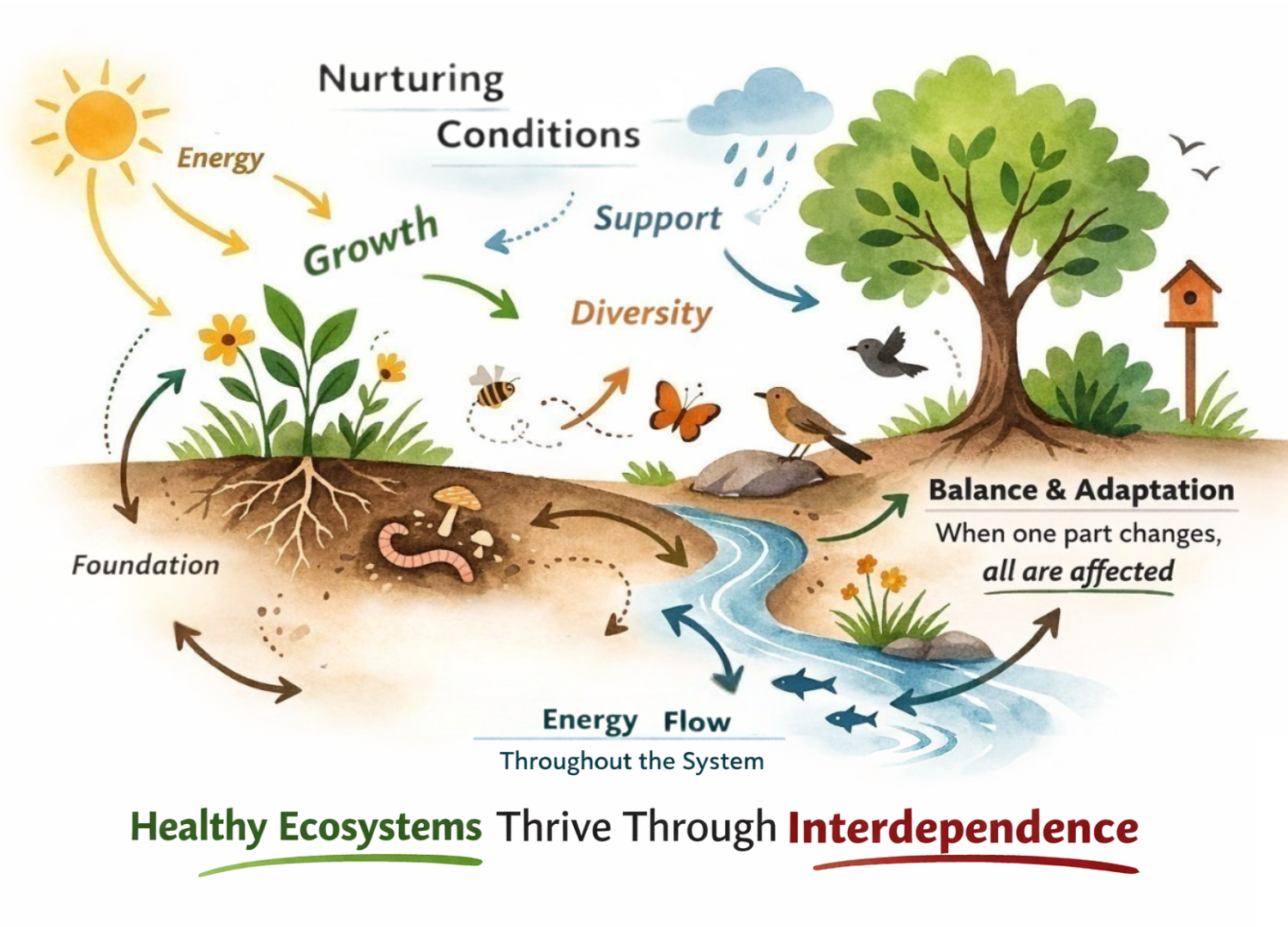
Different organisms contribute different strengths.
Energy flows between participants.
Conditions support growth of all.
Diversity strengthens resilience.
Healthy schools work the same way.
When teachers collaborate, leaders listen, parents contribute insight, and students are invited into the process, the whole system becomes stronger.
Agency spreads.
One empowered teacher inspires another. A confident student influences peers. A trusting relationship with a family strengthens learning.
The system becomes alive.
If schools are ecosystems, the question isn’t, “Who’s in charge?”
The better question is, “What conditions allow everyone to contribute their best?”
Here are a few starting points:
Give teachers room to think.
Provide structures for collaboration, co-planning, and problem solving, not just compliance with mandates.
Invite families into the learning journey.
Families carry deep knowledge about their children. When schools listen, solutions improve.
Teach students how to learn.
Reflection, goal setting, and strategy use build lifelong agency.
Include students with disabilities as decision makers.
Help them understand their strengths, needs, and tools so they can advocate for themselves. Welcome their voice in IEP meetings and support options.
Build cultures of trust.
Agency grows where people feel respected, heard, and capable.
The question, “Who’s in charge?,” shows up everywhere: in classrooms, faculty meetings, and family conversations.
But the healthiest schools move beyond that question.
Instead of asking who holds the power, they ask, “How can each of us contribute?”
When teachers, leaders, families, and students all experience agency, something remarkable happens.
Schools stop feeling like systems that control people. They start feeling like communities where people belong, contribute, and grow.
And that is where real learning begins.