Is it Cheating for Students to Use Artificial Intelligence?
That might be the wrong question.
The same question keeps popping up in conversations everywhere I go - online and in person:
If students use AI, are they cheating?
It reminds me of the same debates when we started seeing hand-held calculators. Was it cheating if students used them in class or at home?
I heard the same debate when spell check, grammar check, and word prediction were included in software. But today, everyone I know uses all of these supports in daily life. Frankly, for students with certain types of learning disabilities and attention issues, these applications make it possible for them to function in the general education classroom and post-secondary education, as well as many employment situations.
But the debate over AI has deeper implications. There’s no question that AI is here to stay. It will impact every aspect of our lives in the near future.
Side note:
Last week the U.S. Department of Labor released its AI Literacy Framework - with five foundational content areas and seven delivery principles for AI literacy.
Publishing such a framework sends a clear message: schools that don’t incorporate AI literacy into education will not prepare students for their future employment.
So schools can’t simply ban AI.
Which brings us back to the original question.
I think “Is it cheating?” is the wrong question.
It avoids the deeper issue.
Let’s step back.
At the deepest level, what is the purpose of education?
Is it to produce correct answers?
Or is it to stretch the brain?
To build cognitive stamina?
To learn how to wrestle with complexity?
To practice solving problems that don’t have neat, tidy solutions?
To collaborate, disagree, revise, and persist?
Underneath all this discussion is the question of self-efficacy.
Let me use a story analogy to make my point.
I have committed to power walking around the block every day. It’s nearly a mile, and I know the exercise is good for my health. I’ve also discovered that if I take my walk in the middle of the day — between calls and concentrated computer time — I return refreshed and ready to jump back in.
Nobody told me to take these walks. Nobody is policing me. It’s totally self-directed. And I’m proud of myself every time I go.

Now, I could jump in my car and circle the block.
It would be faster, more efficient.
Technically, I would have “gone around the block.”
But I would have missed the point.
The purpose wasn’t to complete a lap.
The purpose was to strengthen my heart and muscles.
Education is a brain exercise.
If a student uses AI to generate an answer without thinking, analyzing, questioning, or refining - that’s like driving around the block and claiming you exercised.
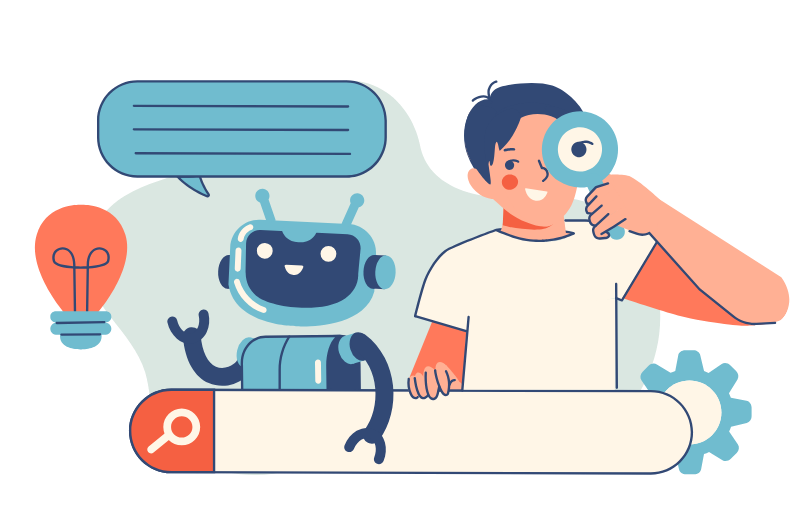
But if a student engages their brain, using AI to:
brainstorm possibilities with thoughtfully prepared prompts
challenge their assumptions
test their reasoning (ask AI if their examples support their claim)
receive feedback on clarity
compare multiple approaches
refine and improve their thinking (verifying the validity of some wild AI statements)
That’s more like using a treadmill, resistance bands, and a heart monitor to deepen the workout.
The tool isn’t the issue - the muscle engagement is.
So maybe the better questions are:
Are students stretching their brains?
Are they learning how to think?
Are they developing problem-solving stamina?
Are they learning how to collaborate - with humans and with tools?
Are they building self-efficacy, or outsourcing it?
Because underneath the cheating debate is a more important issue:
Who is doing the cognitive heavy lifting?
If students never experience the productive struggle of wrestling with ideas, they miss the chance to build confidence in their own capacity.
And that - more than any grade - is the real loss.
Instead of banning AI or ignoring it, schools can:
Redesign assignments so students must explain their reasoning.
Require reflection: How did you use AI? What did you revise? What did you disagree with?
Assess process, not just product.
Teach students when not to use AI.
Make metacognition visible - ask, “What did your brain do here?”
Because the future doesn’t belong to students who avoid AI.
It belongs to students who know how to think with it - without losing themselves in the process.
Let us know your thoughts below, or join us over on Substack.
Want more information about the US Department of Labor AI Literacy Framework?