Equipping Families for True IEP Partnership
“Families are passive participants at our IEP meetings… if they come.”

You’ve probably heard it. Maybe you’ve even felt it.
Maybe you’ve wondered if that means family members don’t care?
It’s an easy conclusion to draw, but it’s also the wrong one.
What if we flipped the script?
Instead of assuming disinterest, what if we made the least dangerous assumption (Donnellan): every parent wants what’s best for their child and is already doing everything they know how to do.
Because when a child has a disability, families are already investing their time, energy, emotion, and finances. They’re in it. Fully.
So if they’re quiet at the table, it’s not apathy.
It’s often uncertainty.

Most families step into their first IEP meeting without a roadmap.
They don’t know the jargon.
They don’t know the expectations.
And they don’t know what questions will actually make a difference.
Meanwhile, educators are sitting there thinking, “Why aren’t they speaking up?”
It’s a classic case of both sides wanting partnership, but missing the bridge.
And here’s the thing: the law already assumes that bridge should exist.
The Endrew F. v. Douglas County School District decision reinforced that families are not just attendees. They are essential partners in determining whether an IEP is designed to help a child make meaningful progress.
So the question becomes: How do we equip families to step into that role with confidence?
One of the most effective ways to build partnership is surprisingly simple:
Give families the right questions.
Not a binder. Not a lecture.
Just clear, purposeful questions that help them engage in the conversation.
To support this, I created a tool: Questions for Families to Ask in the IEP Process
This tool is organized around six essential questions with thoughtful sub-questions, each designed to open up meaningful dialogue, not just polite participation.
Here’s a preview:
1. What is the purpose of this IEP for my child?
This question grounds the entire meeting. It invites the team to explain - clearly, and without jargon - how the child’s disability impacts learning and what this year is truly aiming to accomplish.
When families understand the why, everything else starts to make sense.
2. What are my child’s long-term outcomes?
This shifts the conversation from this year to the bigger picture.
The answer to this question will spark a discussion to ensure that the entire IEP team (families included!) have the same destination in mind.
3. What adjustments will be provided to help my child succeed in the general education curriculum?
This question helps clarify the actual supports. What will be different because of the child’s disability?
It also ensures that everyone is using the same definitions, and have discussed the specialized supports that the child needs to succeed.
4. Is the IEP reasonably calculated to enable my child to make progress?
This one can feel bold. Many families won’t want to ask this question because it feels like questioning the authority of the professional IEP team members.
But it’s also essential.
The law requires that IEPs be designed for meaningful progress. Not minimal movement. Even if families never ask this question, teams are responsible for answering it.
5. Can you help me understand the progress monitoring system for my child’s IEP?
“I think he’s doing better,” doesn’t cut it.
This was an issue in many special education hearings - either the tracking method was too subjective or the data wasn’t understandable by the family.
Families deserve clear, understandable data. This question invites transparency and builds trust - two things every strong partnership needs.
6. How can we work together to build my child’s independence?
This is where the magic happens.
When families ask this, they’re not just participating. They’re partnering.
And when schools respond with openness, the focus shifts from compliance to possibility.
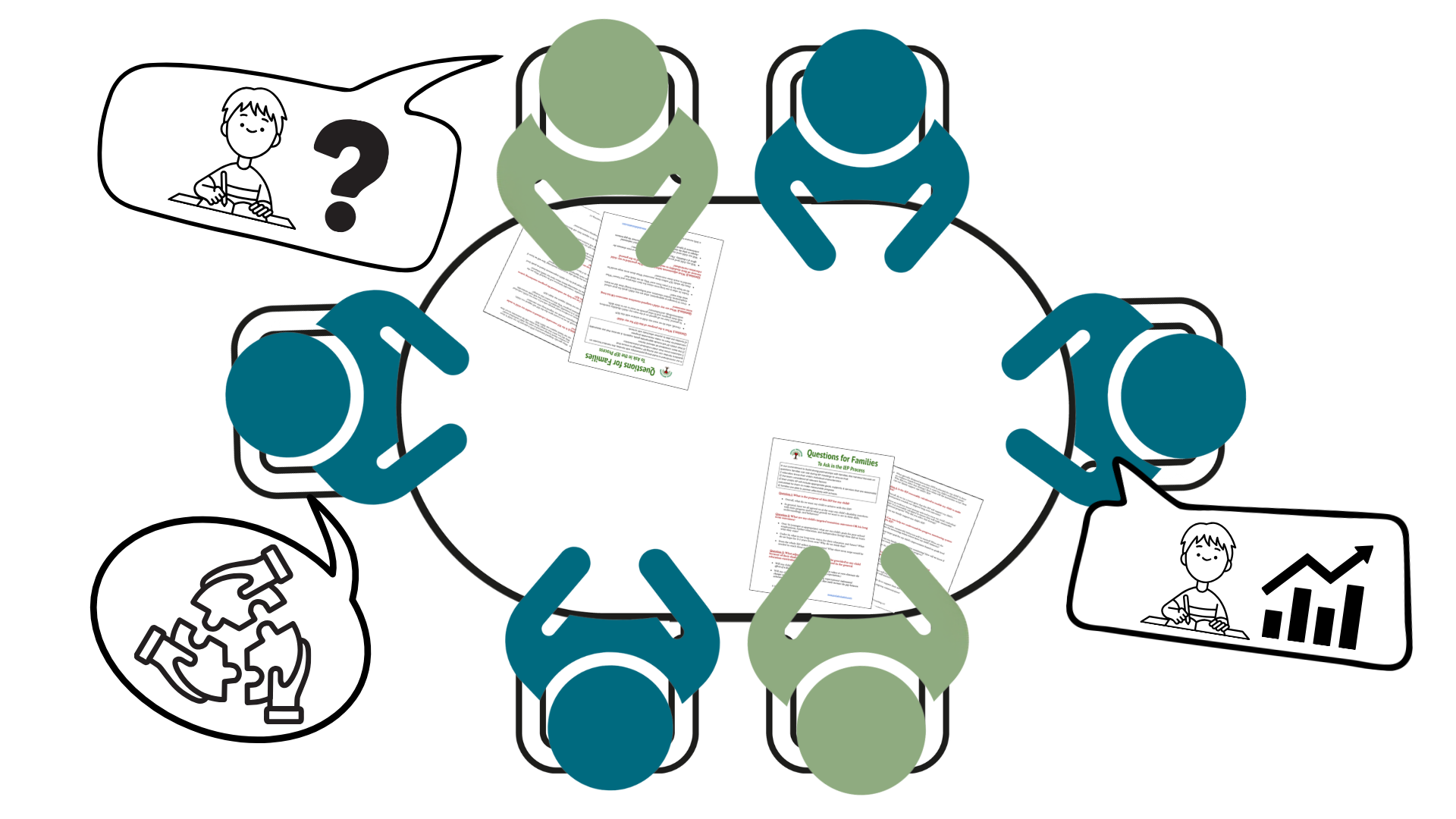
When families have these questions in hand, something changes.
They lean in.
They speak up.
They connect the dots.
And suddenly that “passive participant” becomes an active, informed advocate for their child and a full member of the team.
Not because they’ve changed, but because we’ve removed the barrier.
If we want strong IEP partnerships, we can’t wait for families to figure it out on their own.
We must equip them.
We must invite them.
We must make the path visible.
The Questions for Families to Ask tool is a simple place to start. Use it at family nights, send it home before meetings, or build it into your IEP preparation process.
What would your IEP meetings look like if every family walked in knowing exactly how to participate?
The PDF lists these 6 questions and their sub-questions. Feel free to share with families and professionals learning to build stronger partnerships with families. (Please keep Joyful Inclusion® attribution).
If you liked this blog, you may want to check out our Joyful Inclusion Navigator App.
Grab your favorite beverage and sit down for ~10 minutes to answer questions about inclusion at your school. The Navigator App will analyze your responses into a radar graph and send you personalized actions you can do starting tomorrow to improve inclusion.