“Are we supposed to aim for full inclusion?”
We may be asking the wrong question.
The superintendent looked at me through his Zoom screen. He wanted a clear answer. And I could understand why.
His special education director had one perspective. Local advocates had another. Parents were speaking up, sometimes loudly. Everyone seemed to have a different idea about what the law required and what was best for students with disabilities.
He had reached out because we had worked together on a project 20 years earlier. He knew I had spent much of my career in special education and continued to follow the research, legal decisions, and changing practices in our field.
Now he was looking to me for some clarity.
“Well,” I said, looking into the eyes on my screen, “the answer is YES and NO.”
Not exactly the simple answer he was hoping for, but it was the most honest one I could give.
Because when we talk about full inclusion, we are really asking two different questions. One is about what the law requires. The other is about what we believe every child deserves. And those answers don't always lead us to the same place. Let me explain.
What the law actually says about inclusion:
The law favors inclusion, but it does not require every child to spend every minute in a general education classroom.
That's an important distinction, especially when emotions run high.
The legal foundation comes from the Individuals with Disabilities Education Improvement Act (IDEA, 2004), its federal regulations, and court decisions that have helped clarify how the law should be applied.
I promise to keep this brief. Partly because a deep dive into special education law could fill a book. And partly because I'm an educator, not an attorney.
For those who want to go deeper, I recommend the webinar Dr. Mitch Yell presented for the Council for Exceptional Children on October 28, 2026. It's available to CEC members on their website.
Here are the points I believe every school leader and IEP team should understand.
First, design the education. Then decide the location.
The biggest mistake an IEP team can make is deciding where a child belongs before deciding what the child needs.
Under IDEA, the first responsibility of the IEP team, including the parent, is to develop a plan that provides a free appropriate public education (FAPE). That means identifying the student's unique needs, setting meaningful goals, and determining the special education, related services, and supports needed to make appropriate progress. Only after that plan is developed should the team turn to the question of placement.
Think about the difference.
One team begins by saying, “Students like this belong in our special education classroom.”
Another begins by asking, “What does this student need to learn, and what supports will help make that possible?”
The first team starts with a room. The second starts with a child. And that difference matters.
Second, the starting point is general education.
IDEA establishes a strong presumption that students with disabilities will learn alongside peers without disabilities to the maximum extent appropriate.
The law states:
“To the maximum extent appropriate, children with disabilities ... are educated with children who are not disabled.”
That means we should be concerned when we hear statements such as:
“All our students with autism go to the autism classroom.”
“Andy's teacher decided he belongs in Setting C.”
“When Sheila improves her behavior, she can return to the regular classroom.”
“We don't have the program this child needs, so we have to place him elsewhere.”
Each statement assumes that placement can be decided by a label, an adult's preference, or the programs a school happens to offer.
A disability label is not a placement decision.
A child should not have to earn the right to be considered for general education.
Instead, teams must consider the supports and services that would make education in the general classroom possible.
Third, there are legitimate exceptions.
IDEA does not require full inclusion for every student. The law permits removal from general education when education in regular classes, even with supplementary aids and services, cannot be achieved satisfactorily.
Court decisions, including Roncker v. Walter, Daniel R.R. v. State Board of Education, and Sacramento City Unified School District v. Rachel H., have helped shape how teams make these decisions. The specific legal tests vary by federal circuit.
In practical terms, the team should consider several questions.
What academic and social benefits might the student receive in general education?
What benefits might a more specialized setting provide?
What supports have been considered? How would the student's placement affect instruction and learning?
And if some time outside general education is necessary, how can the student continue to participate with peers without disabilities?
IDEA also requires schools to provide a Continuum of Alternative Placements. Options range from general education with appropriate supports to special classes, special schools, and more restrictive settings when necessary.
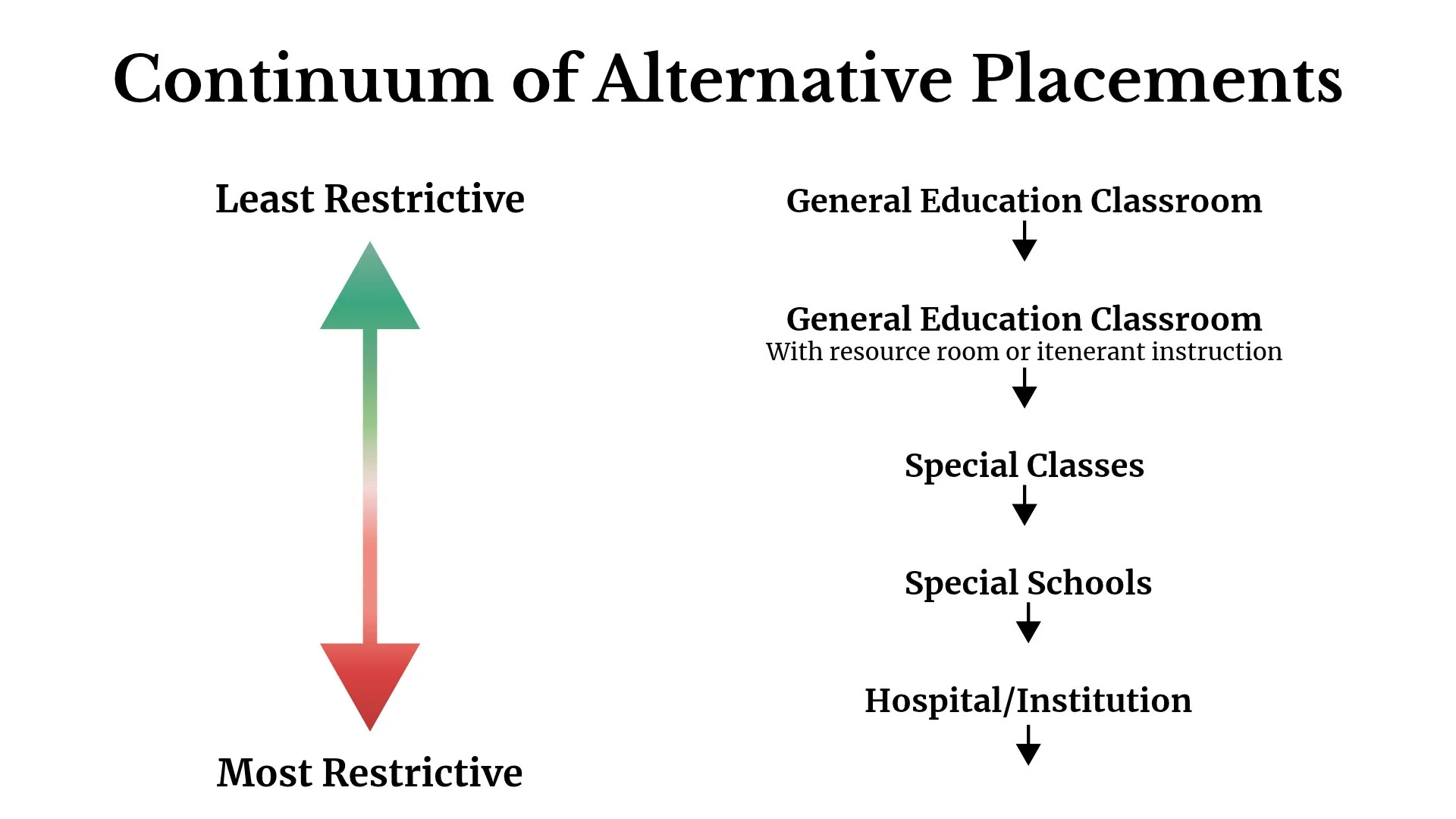
These decisions must be individualized, based on the student's needs and the legal requirements for placement. They are not decided by a simple majority vote. Parents are essential members of the team, and procedural safeguards apply when disagreements arise.
So, legally, the answer to my superintendent friend is NO. We are not required to place every child with an IEP in a general education classroom for the entire day.
But neither are we free to exclude a child simply because inclusion is difficult.
The law gives us a clear direction: Begin with the expectation of learning together, provide appropriate supports, and make exceptions based on individual needs.
That is the legal responsibility. But it is only half the conversation.
The question the law can't answer for us:
Following the law is essential, but it doesn't settle every question about what is right.
To understand the ethical side of inclusion, I think we need to return to the original intent of special education legislation.
In 1974, Senator Robert T. Stafford made a statement that has stayed relevant for more than 50 years:
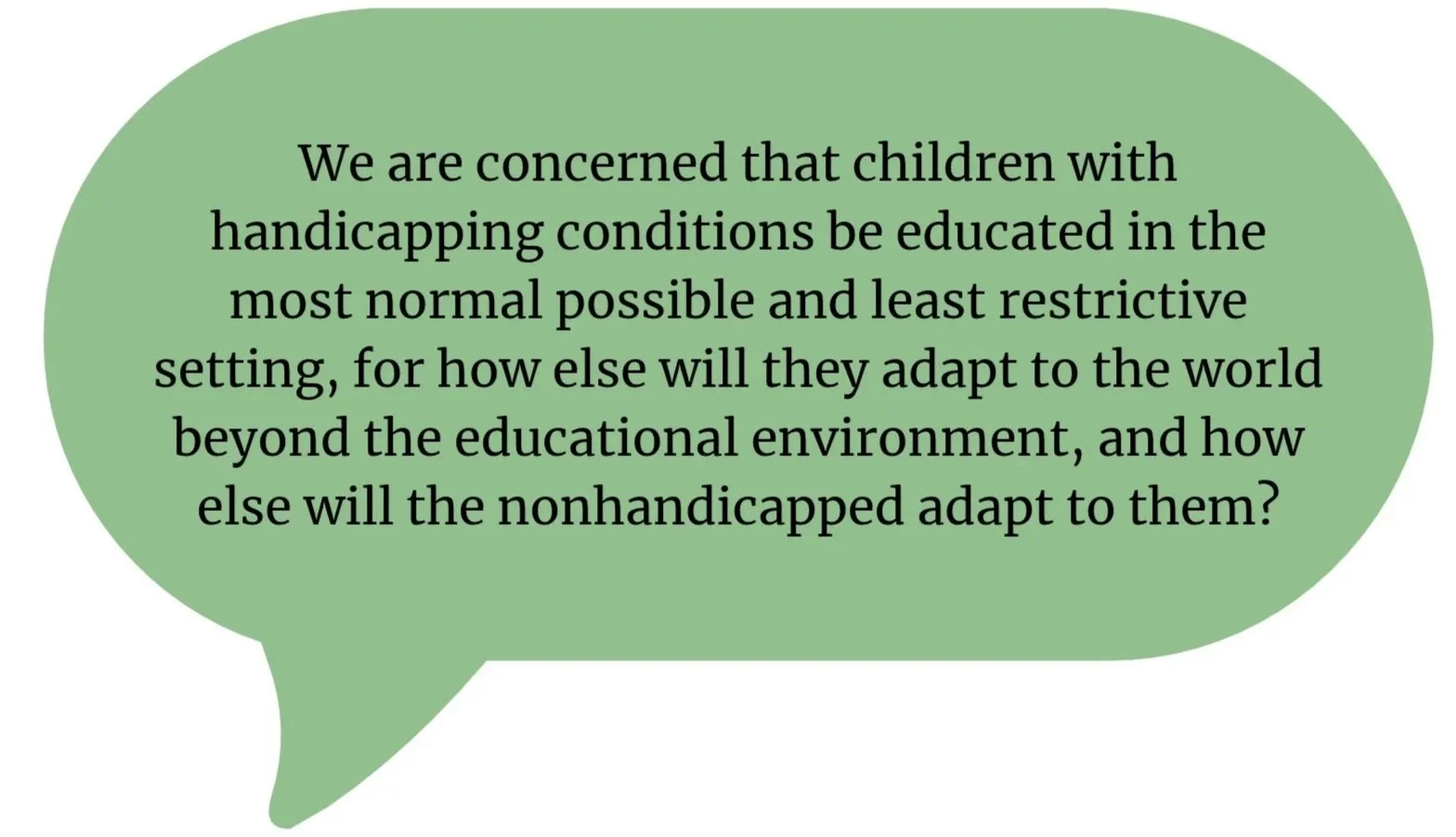
Read that last part again.
How will children with disabilities learn to live in a world that includes people without disabilities? And just as important, how will people without disabilities learn to live and work alongside them?
Senator Stafford was looking beyond the classroom. He was talking about the kind of society we were preparing children to enter. A society where people of different abilities live in the same neighborhoods, work in the same businesses, shop in the same stores, and contribute to the same communities.
That raises a much bigger question. If we want children to live together as adults, shouldn't we give them opportunities to learn together as children?
I believe there are three strong ethical reasons to make inclusion our goal whenever it can be achieved appropriately.
And the first may be the most important.
Belonging is more than having a seat in the classroom.
A child can sit in the middle of a classroom and still feel completely alone.
Imagine a student named Adam. He's in a general education classroom for most of the school day. He has a desk, a schedule, and an assigned seat. On paper, he is fully included.
But when students work in groups, Adam usually works with an adult. At lunch, he sits near his classmates but rarely talks with them. During classroom discussions, the teacher seldom calls on him because she isn't sure how he will respond.
At the end of the day, Adam has spent six hours surrounded by other children. But has he belonged?
This is the difference between being present and being included.
You may be familiar with Abraham Maslow's hierarchy of needs. His work reminds us that human beings need more than food, shelter, and physical safety. We also need relationships, acceptance, and a sense of belonging.
That need doesn't disappear when a child has a disability. In fact, it may become even more important when a child already feels different from peers.
So here's what I encourage educators to ask:
Does Adam have opportunities to interact with classmates? Does he participate in learning and social activities? Are his contributions noticed and valued? Does he have relationships with peers as well as adults?
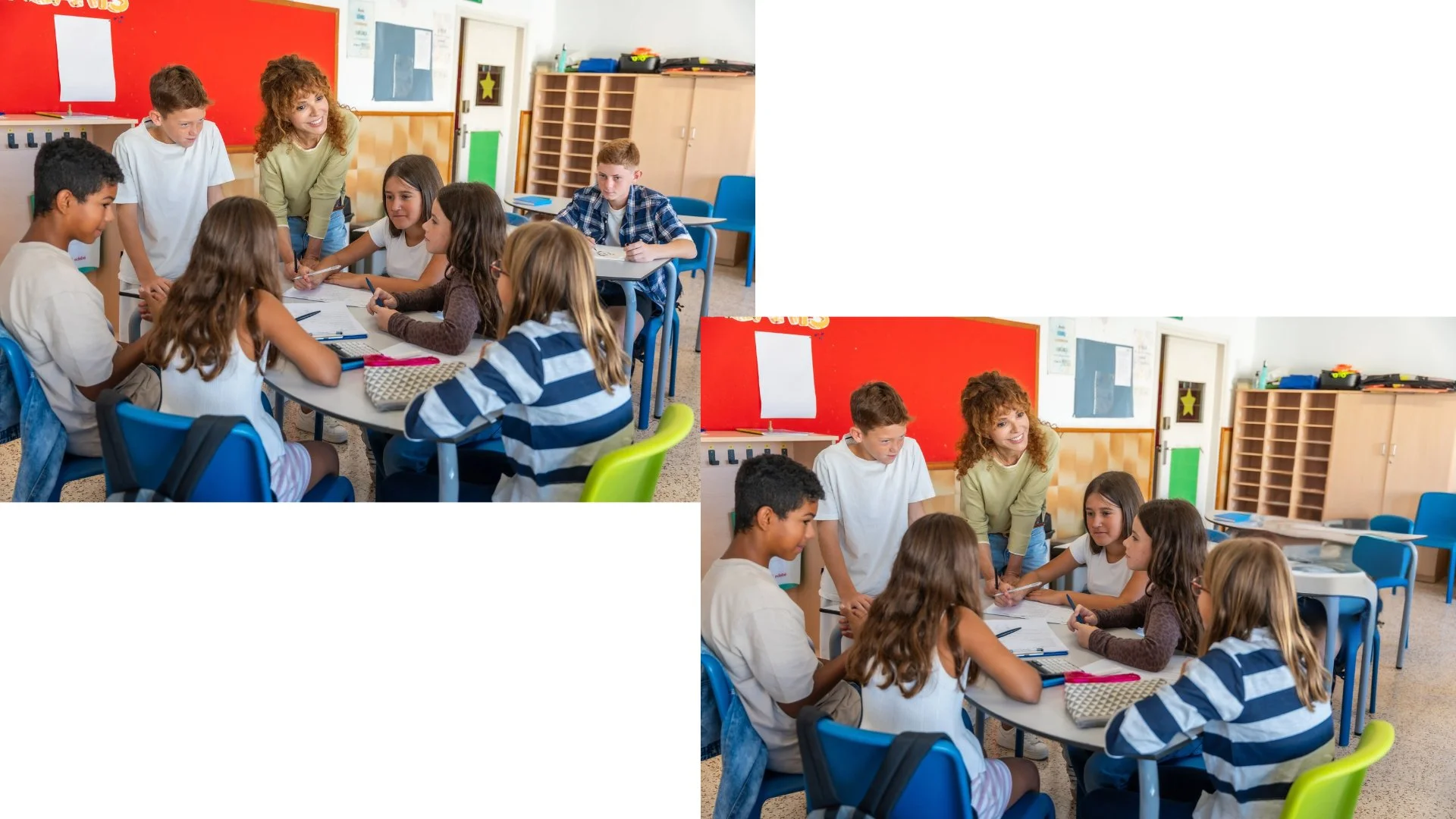
And perhaps the most revealing question of all: If Adam were absent tomorrow, would anyone miss him?
That question tells us more about inclusion than a placement code or a percentage of time spent in general education.
Because true inclusion isn't measured only by where a student sits.
It's reflected in the relationships that develop, the opportunities to contribute, and the feeling that you are an important part of the group.
Being in the room is a placement. Being part of the room is belonging.
What the research tells us about learning together:
Inclusion isn't just a feel-good idea. When it's done well, students benefit.
Research has documented important academic and long-term benefits associated with educating students with disabilities in general education settings.
Consider some findings highlighted in the literature:
John Hattie's Visible Learning research reports an effect size of 0.52 associated with mainstreaming, indicating a meaningful positive relationship with achievement.
Longitudinal research has linked greater participation in general education with outcomes such as earning a diploma, entering postsecondary education, employment, and independent living.
Hattie's work also highlights the importance of teacher expectations, including teacher estimates of achievement (1.30), and the powerful influence of collective teacher efficacy (1.34).
These findings deserve careful interpretation. Research findings do not mean that simply placing a student in general education will produce better outcomes. The quality of instruction, relationships, expectations, and support matters. But the overall message is encouraging. Students can benefit when schools create meaningful opportunities to learn together.
And those benefits are not limited to students with disabilities. Research has also documented social benefits for peers without disabilities, including greater empathy, understanding, and appreciation of differences.
Think about a common classroom experience.
A student is struggling to solve a math problem. Another student leans over and explains the steps in a different way. The first student gains a new understanding. The second student discovers that explaining something can deepen their own learning. Both have benefited.
Now imagine that same exchange happening across differences in background knowledge, language, or ability. The lesson extends beyond math.
Children discover that everyone has strengths, everyone needs help sometimes, and everyone has something to contribute.
Of course, none of this happens automatically. Teachers need time, resources, training, and opportunities to collaborate. School leaders need to make those conditions possible.
That's why I find the research on collective teacher efficacy especially compelling. When educators believe they can make a difference together, student achievement benefits.
Inclusion is not a seating arrangement. It's a commitment to social justice.
I once taught in a setting that I would question today.
In 1978, I made the switch to special educator teaching a self-contained classroom of students in grades six through eight.
My students had a wide range of abilities and disabilities. Since the ink was still fresh on the first special education law, most of my students had been identified as having a disability less than a year before they arrived in my classroom.
We had a lot of catching up to do.
I taught English, social studies, science, and math. My teaching credentials were in English, reading, and special education. I worked hard to meet my students' needs across every subject, but I couldn't bring the same depth of content knowledge that a subject specialist could offer in every area.
I wanted my students to succeed, and I was doing what I believed was best at the time. Looking back, I see something I didn't fully understand then.
My students may have received better instruction in science, math, and social studies if they had access to general education teachers. We should have been asking how to give them access to stronger instruction while also meeting their individual needs.
I share this because I know how easy it is for caring educators to work within a system without questioning its assumptions. We were doing what we thought was right. But good intentions don't always produce the best opportunities.
This is where the social justice argument becomes impossible to ignore.
The Supreme Court's 1954 decision in Brown v. Board of Education established that racial segregation in public education was unconstitutional. Although that case addressed racial segregation, its larger lesson about equal educational opportunity continues to challenge us.
We must be careful not to treat racial segregation and disability placement as legally identical. IDEA expressly recognizes that some students need more specialized settings. Still, the ethical question remains.
When we separate students because of a disability, are we providing something they truly need? Or are we limiting their opportunities because of what we assume they cannot do?
I cannot go back to my classroom in 1978. But I can keep asking better questions today. And I hope we all will.
The real test comes after students leave school
What happens after graduation may be the strongest reason to rethink inclusion today.
Let's return to Senator Stafford's question. How will children with disabilities adapt to the world beyond school? And how will the rest of society learn to welcome and work alongside them?
Eventually, every student leaves public education. Some go to college. Some enter job training programs. Some find employment. Others need ongoing support to participate in adult life. But every one of them becomes part of a larger community. And that larger community is not divided neatly into general education and special education. It is one world.
Yet we have a troubling problem.
Employment data from the U.S. Bureau of Labor Statistics show a persistent gap between adults with and without disabilities (ages 16-65).
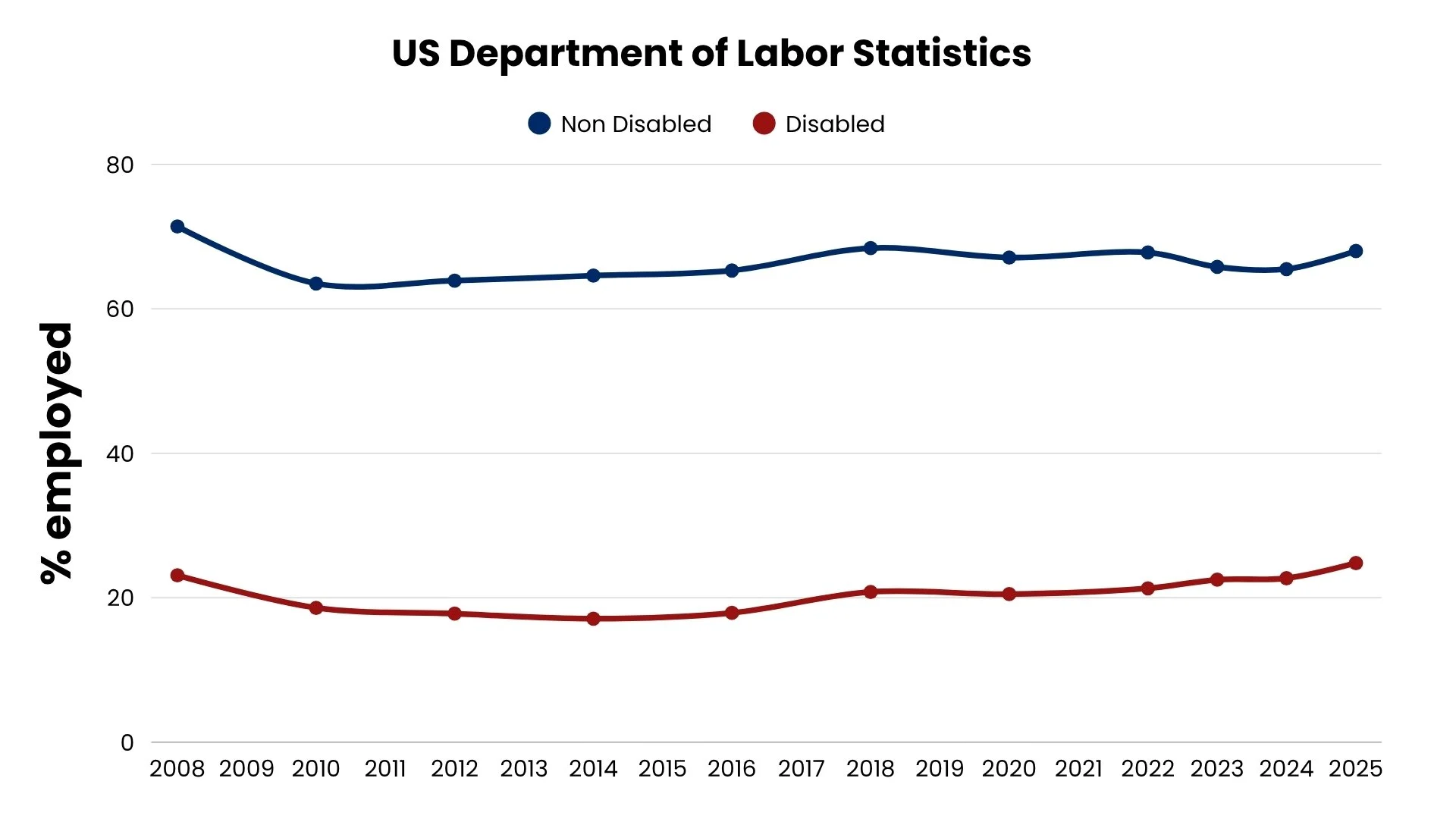
Look at the distance between those two lines. The graph shows employment rates for people with disabilities remaining far below those for people without disabilities across the years.
The numbers alone cannot tell us why the gap exists. Employment is affected by many factors, including discrimination, accessibility, health, education, the economy, available supports, and opportunities.
But there is an important connection worth considering. Our experiences in school help shape what we expect from ourselves and from other people. Did those employers and those employees grow up knowing the variable needs and abilities are part of “normal” or did they learn that some people don’t belong?
Research has raised concerns that segregated educational experiences can contribute to lower expectations and limited opportunities for individuals with disabilities. Limited contact can also reinforce uncertainty, stigma, and negative assumptions among people without disabilities.
This is not to suggest that school placement alone determines someone's future. It doesn't. But it does raise a question we cannot afford to ignore.
Are our schools helping children prepare for the communities they will join? Or are we teaching them, year after year, that people with different abilities belong in different places?
If we separate children throughout their school years, we shouldn't be surprised when adults struggle to live and work together.
That is why inclusion matters far beyond the classroom door.
So, should we aim for full inclusion?
My answer is still yes and no, but I hope you can see why.
No, we should not insist that every student spend every moment in general education, regardless of their individual needs. Some children need specialized instruction, intensive support, or a different setting for part or all of their school day. We must preserve those options and make placement decisions carefully.
But yes, we should aim to create schoos where every child has the greatest appropriate opportunity to learn, participate, contribute, and belong alongside peers without disabilities. We should begin with what is possible, not with what has always been done.
And we should resist two habits that quietly limit children's futures. The first is the belief that a student's disability tells us where that student belongs. The second is the belief that putting a student in a general education classroom is enough to call it inclusion. Neither serves children well.
Inclusion without support is not a success.
Specialized support without meaningful opportunities to belong is not enough, either. The real work is finding the right balance for each child, then being willing to change that balance as the child grows.
I would encourage my superintendent friend to bring his team together around a different set of questions. Not simply, “How many of our students are fully included?”
But rather:
Are we providing the instruction and supports each student needs to succeed?
Are we giving all students meaningful opportunities to learn and build relationships with peers?
Are we making placement decisions based on individual needs rather than labels or available programs?
And are we preparing all our students for life beyond school?
Those questions are more demanding than choosing between full inclusion and separate placement. They also lead us closer to the purpose of public education. Because one day, the students sitting in our classrooms will become coworkers, neighbors, employers, friends, and members of our communities.
The child who learns to work alongside someone with a disability today may become the employer who welcomes that person tomorrow. The child who learns to ask for help and advocate for needed supports today may become the adult who knows how to speak up for themselves tomorrow.
And the classmates who learn to value one another today may carry that respect into every part of their adult lives. That's the future we should be preparing them for.
So perhaps the most important question isn't whether we are supposed to aim for full inclusion. It's whether we are willing to build schools that prepare every child to participate in a world where everyone belongs.
Because the ultimate goal isn't simply to include children in our classrooms. It's to prepare all of them to include one another in the world.