Sometimes a stranger says something that stays with you for weeks.
I was standing at a conference registration table, admiring something most people would probably walk right past: the nametags.
Yes, the nametags.
I've attended hundreds of conferences, but I'd never seen a registration table arranged quite like this one.
The volunteer had turned an ordinary task into a work of art. Nametags for attendees whose last names began with A through D had blue lanyards, E through K had red ones, and so on. She had arranged them in alternating stripes of color across the table.
But the real magic was in the placement of the lanyards.
She had carefully aligned them so they cascaded over the edge of the table, creating a waterfall of red and blue that flowed all the way to the floor.
It was stunning.
I paused to admire her work. I imagined the time she had spent arranging each one, getting the colors just right, and making sure everything lined up.
Someone had taken a simple task and made it beautiful. And somehow, her care felt personal.
"This is beautiful!" I told her. "I love how you arranged these nametags!"
I wanted her to know that I noticed. That her work mattered. That she had made my day a little brighter.
Her response stopped me. "Oh, sorry about that. I have OCD and can't help myself."
Sorry?
I had offered a compliment, and she responded with an apology. Instead of accepting my appreciation, she explained her attention to detail with a disability label.
I don't know whether she has OCD, and I certainly can't know what she was thinking. But I know what I saw.
I saw creativity. Thoughtfulness. Pride in a job well done.
She seemed to see something she needed to explain.
What if the very thing we're apologizing for is something someone else admires?
Weeks later, I'm still thinking about that exchange.
Not because of the nametags. Because of the apology. And because I'm noticing similar conversations everywhere.
When did we start explaining our differences instead of appreciating them? When did labels become everyday explanations?
We've become surprisingly quick to diagnose our own behavior.
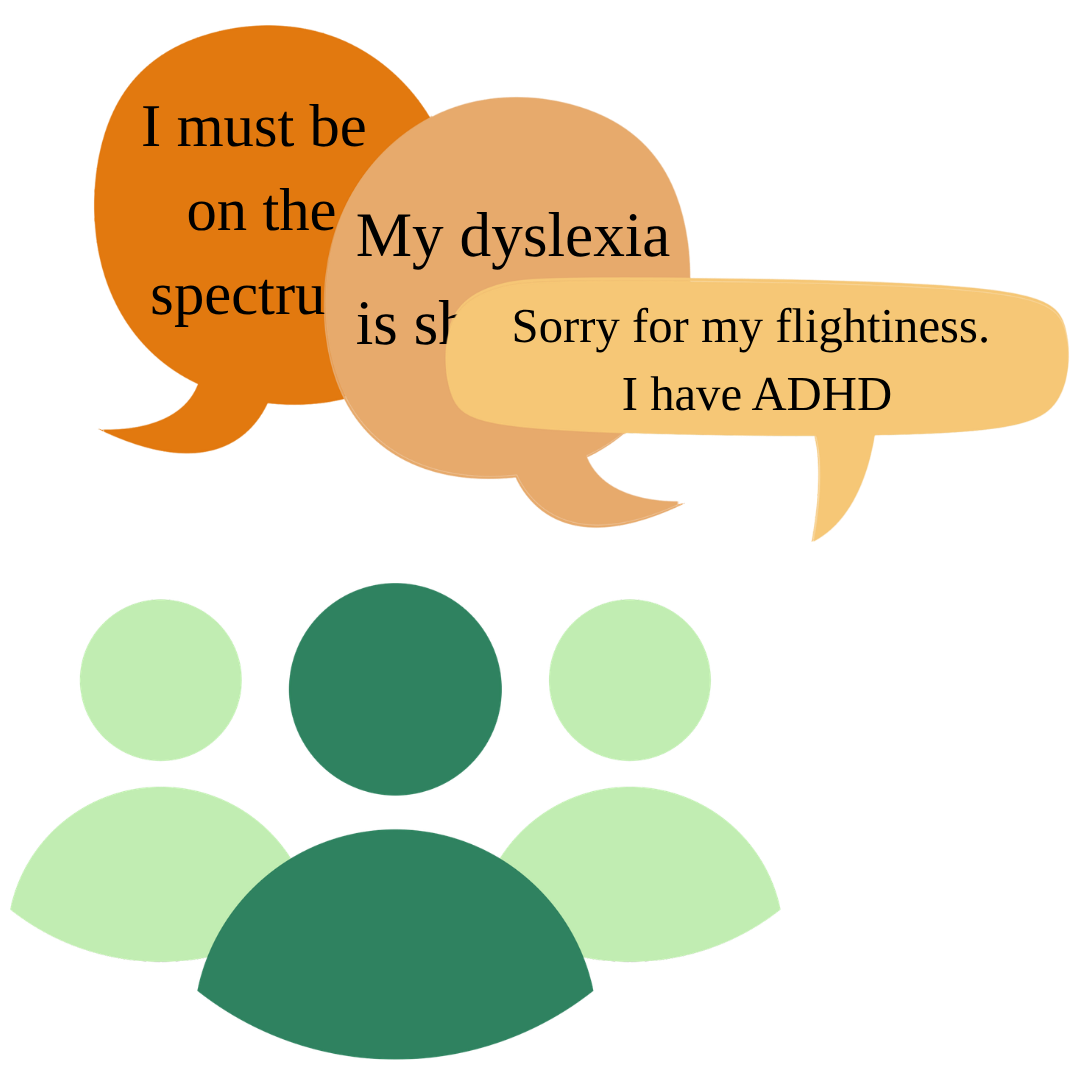
"Sorry for my flightiness. I have ADHD."
“Oops. My dyslexia is showing."
"Please excuse me. I must be on the spectrum."
Have you noticed this too?
I hear comments like these in ordinary conversations among adults who are going about their daily lives.
And I find myself wondering: Have these people been diagnosed? Are they making a joke? Or have disability labels become convenient ways to explain perfectly human differences?
For years, people often hid their disabilities because they feared judgment or shame. Now, in some circles, the language of disability seems to have become part of everyday conversation.
In many ways, that's progress.
People are more willing to talk about their experiences. A diagnosis can bring understanding, relief, accommodations, and a sense of belonging. And disabilities aren't always visible. Someone can appear capable and successful while facing very real challenges.
But there's a difference between understanding a disability and using diagnostic language to explain every quirk or mistake.
Imagine someone losing their train of thought during a meeting. They laugh and say, "There goes my ADHD again."
Maybe they have ADHD. Maybe they're simply distracted, tired, or overwhelmed. We can't know. But I wonder what happens when we begin treating ordinary human variation as something that always needs a label.
The myth that we're all supposed to think, work, and behave alike is a sneaky thief. It robs us of our appreciation for human differences.
Not every unusual habit is a symptom. Not every difference is a disorder.
And even when a diagnosis is real, it doesn't explain everything about a person. That's the distinction I think we're losing.
A diagnosis can help explain how we experience the world. It should never become the whole explanation of who we are.
I've seen what happens when a label feels bigger than the person carrying it.
For years, I worked as a Special Education Transition Coordinator, helping middle and high school students understand their disabilities and learn how to advocate for themselves.
We explored how their disabilities affected their learning and their lives. We talked about accommodations they might need in college, at work, and in the community. But we always began with their strengths.
I remember Shawn. Like many teenagers, he desperately wanted to fit in. The thought of having a disability was appalling to him. He didn't want to be different. He didn't want to be labeled. He wanted to belong.
Imagine being a teenager, already trying to figure out who you are and where you fit. Then you're given a label that you fear will set you apart from everyone else. Will your classmates see you differently? Will teachers expect less of you? Will people notice your disability before they notice anything else about you? Suddenly, one word seems to carry the weight of your entire future.
That's the fear we had to work through. Much of my early work with Shawn focused on helping him recognize his gifts. Yes, he had a disability. Yes, understanding it was important. And yes, learning to request accommodations would help him succeed.
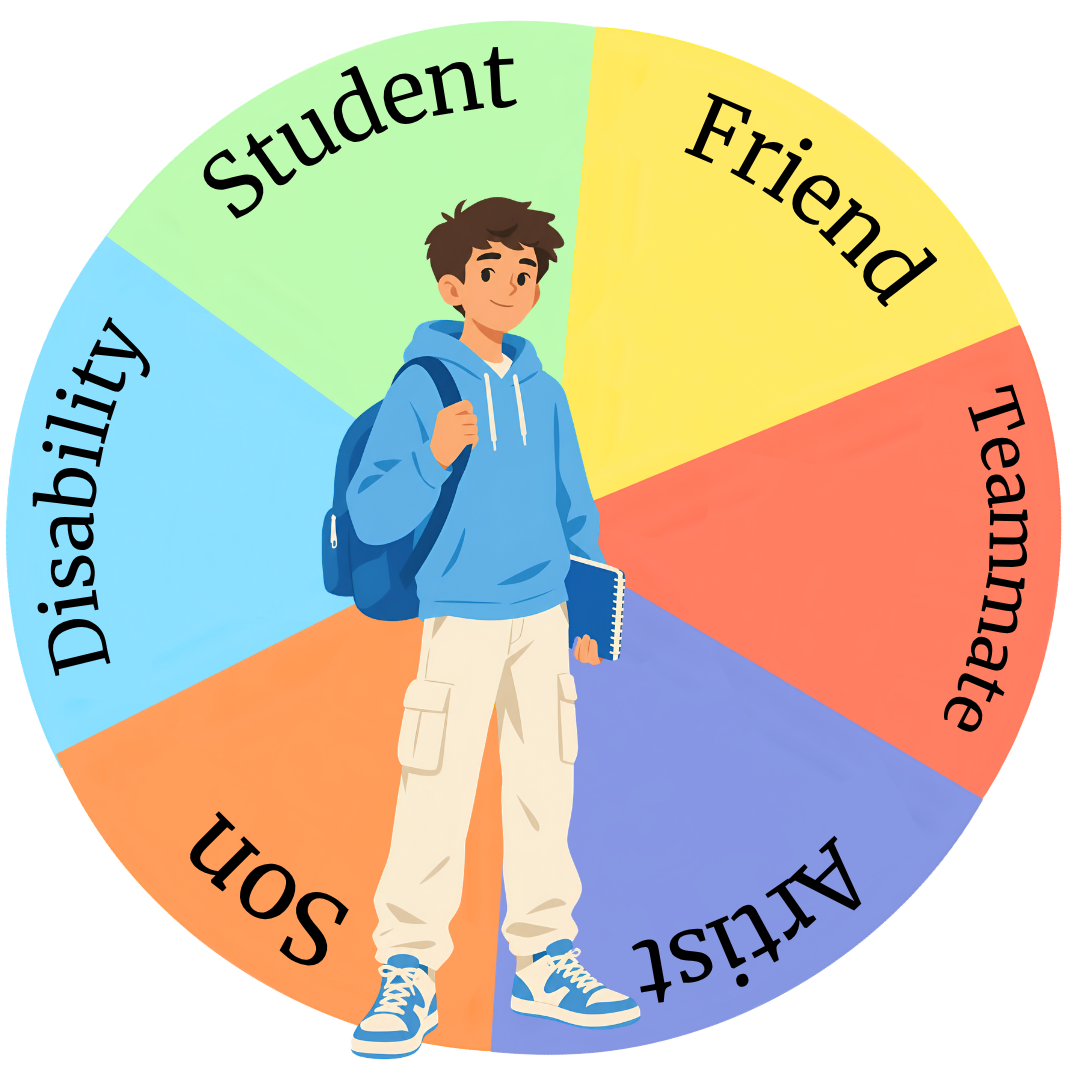
But his disability was only ONE of his identities.
He was also a young man with talents, interests, relationships, hopes, and dreams.
The label described something important about him. It didn't define him.
We don't empower people by ignoring their disabilities. We empower them by making sure their disabilities aren't all we see.
That's what makes today's casual use of disability labels so interesting to me. Years ago, I was helping young people understand that they were more than their diagnoses. Today, I hear adults using those same labels to explain who they are.
We've moved from hiding labels to sometimes embracing them. But have we learned to put them in perspective?
The goal isn't to reject a label. It's to remember everything else that belongs beside it.
Maybe our growing attachment to labels reveals something deeper.
This morning, during a conference call, I asked several educators whether they had noticed people casually identifying themselves with disability labels like the volunteer at the conference.
"Yes," one educator said. "It's everywhere." Then she added something that caught my attention. "I think it's an attempt to have an identity in a homogenized world."
A homogenized world. I've been thinking about that phrase.
We're encouraged to meet the same standards, follow the same trends, and fit into the same definitions of success. Yet we also want to be recognized as individuals.
We want to be different enough to matter, but similar enough to belong. A label can help us find that balance.
Imagine someone who has spent years feeling out of step with others. Everyday tasks seem harder than they should. Conversations can be exhausting. They wonder why things that appear easy for everyone else require so much effort. Then they discover people who describe similar experiences. For the first time, they hear, "Me too." They have language for something they struggled to understand, and they no longer feel so alone.
That's the power of finding a name for our experiences. But there's a catch.
When belonging depends too heavily on one identity, we risk dividing ourselves into smaller and smaller groups.
People Like Me versus People Not Like Me. Us versus Them.
The same label that helps us feel understood can also become a wall that separates us from others. And when we see ourselves through only one identity, we may begin seeing everyone else the same way.
Belonging shouldn't require us to reduce ourselves to a category.
The pressure to fit in already asks us to hide enough of ourselves. We don't need to replace one narrow box with another. We can honor the experiences we share without overlooking the many ways we're different.
Real belonging makes room for the whole person, not just the part that fits the group.
How many identities do you have?
Here's a simple activity that offers a different way to see ourselves.
My colleague's comment reminded me of an activity in our Joyful Educator Library called the Identity Wheel. I've used it for years in graduate classes and workshops. Teachers have also used it with their students and shared how valuable it was.
I didn't invent the idea, and unfortunately, I don't remember where I first learned it. But I love what it reveals.
We each have far more identities than we realize. Think about mine:
Family roles: I'm a mother, sister, wife, grandmother, and aunt.
Professional roles: I'm a teacher, coach, podcast host, and speaker.
Demographics: I'm a white woman, a senior, and an American.
Recreation interests: I'm a gardener, artist, musician, and hiker.
And that's hardly a complete list. How many identities do I have? I don't think there's a limit.
Some identities have been with me my entire life. Others developed through relationships, work, and experiences.
Some matter more in certain settings than others. When I'm in my garden, being a gardener comes to the forefront. When I'm with my grandson, I'm Mimi. When I'm working with educators, my coach identity takes center stage.
I'm still the same person. But different parts of me shine at different times.
Now imagine a student who has spent years being known primarily as "the kid with a disability." Through the Identity Wheel, that student might also discover identities as a brother, an athlete, an artist, a friend, a gamer, or someone who loves animals.
Imagine how differently that student might begin to see himself. And imagine how differently his classmates might see him.
That's why I love this activity. It makes the invisible parts of us visible. It reminds us that our identities overlap, change, and grow. And it helps us find unexpected connections with people we once thought were different from us.
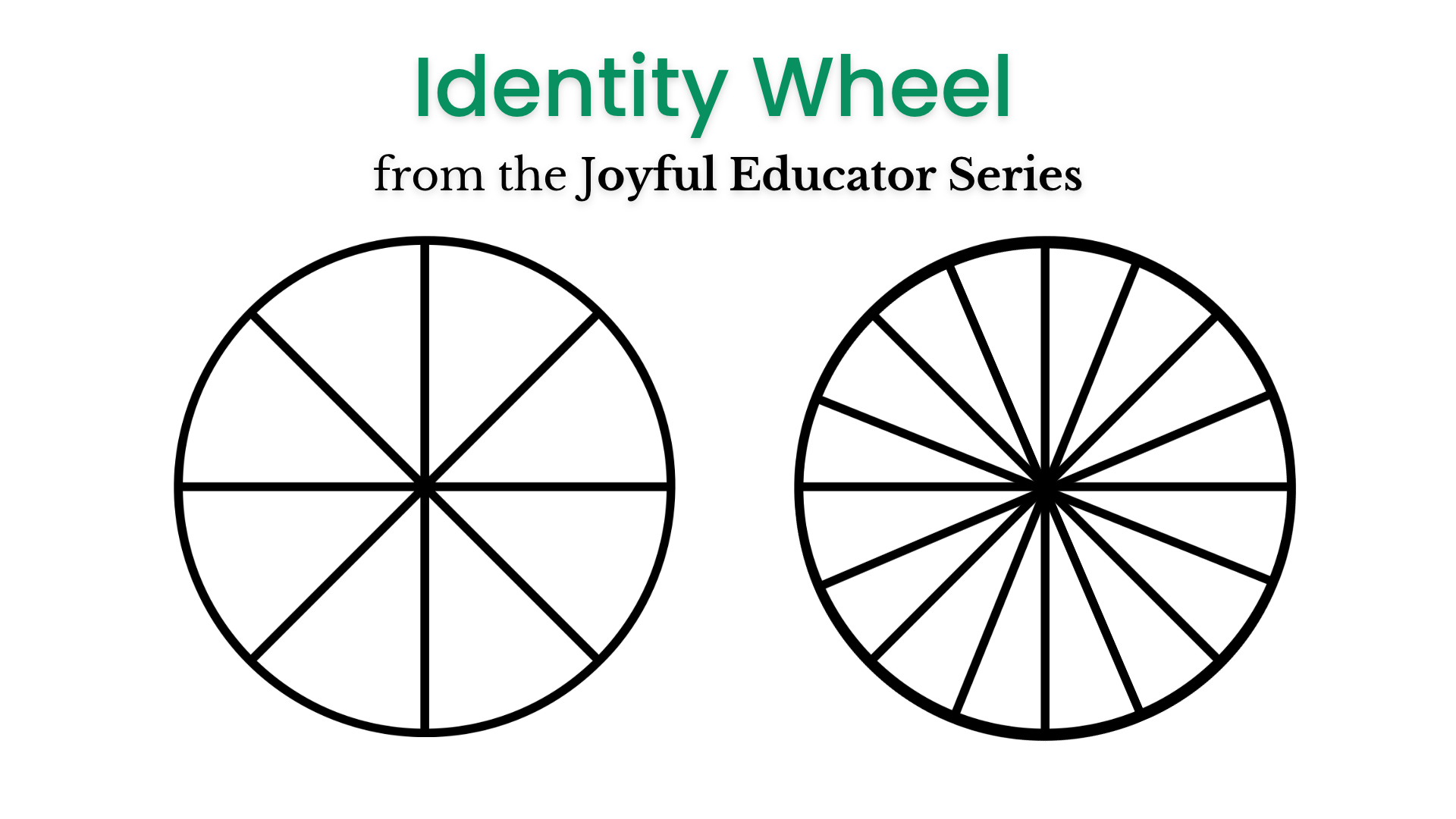
The more identities we recognize, the harder it becomes to define anyone by just one.
The danger isn't having labels. It's seeing only labels.
One piece of a person can never tell the whole story. This is where I think our real identity crisis begins. Not when people openly discuss disabilities. Not when people find comfort in shared experiences. Not when someone proudly claims an identity that once caused shame.
Those can all be healthy steps toward self-understanding.
The trouble starts when one label becomes the lens through which we see everything else. It's like looking at a beautiful stained-glass window through a tiny hole. You see one color. Maybe red. Maybe blue. But you miss the whole picture.
We do this constantly. We see someone's age, race, political views, job, or disability. We make assumptions. We decide who they are before we've taken the time to know them. And our world gets smaller.
A label can offer useful information. But when it becomes a substitute for curiosity, it limits our understanding.
Labels should help us understand people, not give us permission to stop learning about them.
What if we approached people with a different question?
Instead of asking, "What category does this person fit into?", what if we asked, "What else is true about this person?"
That's a question worth asking in classrooms, workplaces, communities, and even within our own families. Because none of us is as simple as the labels we carry.
See the label when it matters. See the whole person always.
What if we stopped apologizing for being ourselves? I keep coming back to that waterfall of red and blue lanyards. The carefully arranged nametags. The thoughtfulness of a volunteer who turned a routine task into something memorable.
And her unexpected apology. "Oh, sorry about that. I have OCD and can't help myself."
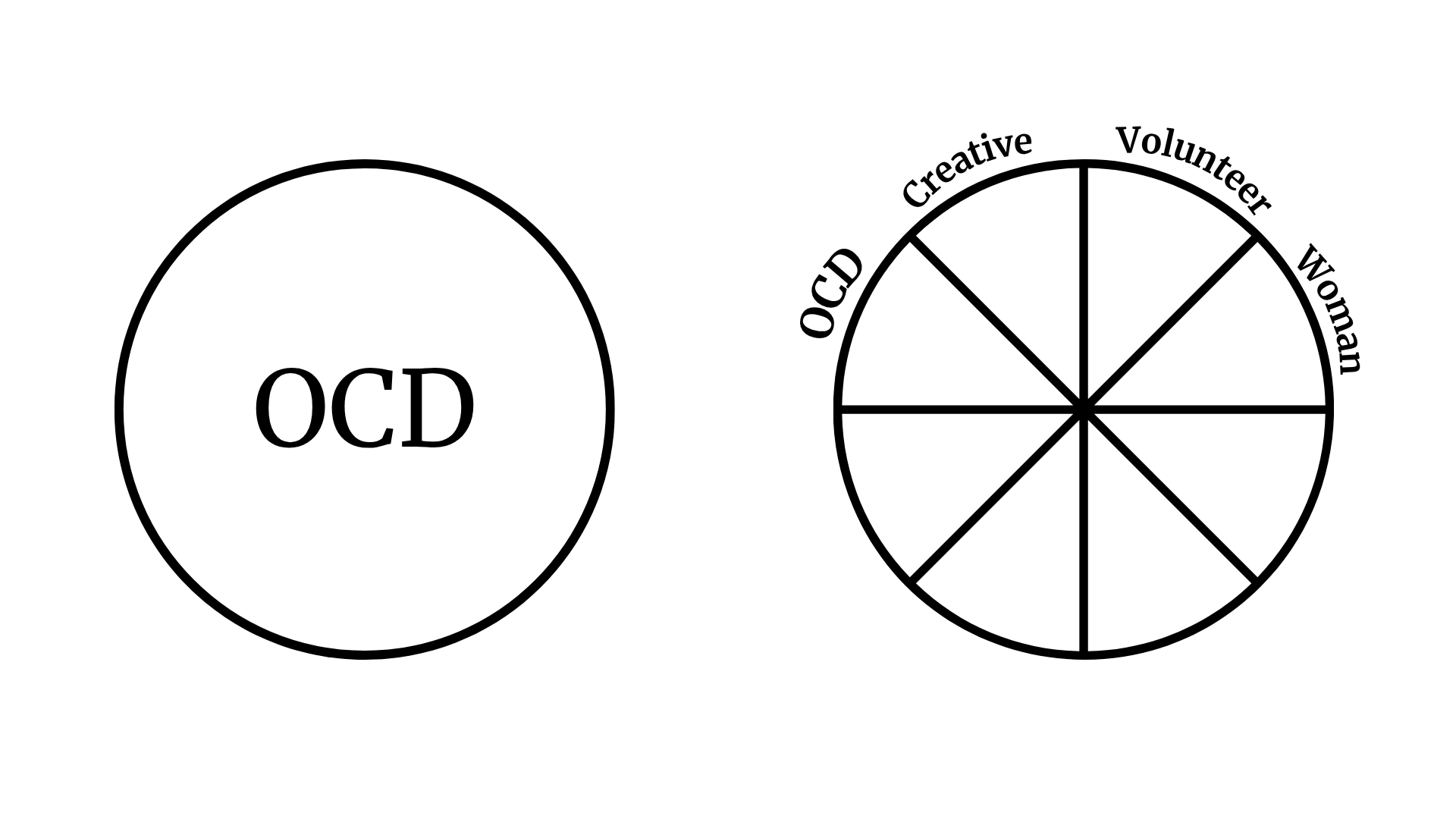
I wish she could have seen what I saw. Not because there's anything wrong with having OCD.
But because whatever challenges or differences she may experience, they weren't the only things worth noticing that morning.
Her creativity was worth noticing. Her care was worth noticing. Her beautiful work was worth celebrating. And I wonder how often we miss those qualities in ourselves and others because we're so focused on the labels.
Maybe our identity crisis isn't that we've become too comfortable claiming identities. Maybe it's that we've forgotten how many we have.
So here's my invitation. Take a few minutes and create your own Identity Wheel.
Write your name in the center of a page and surround it with the many identities that make you who you are. Include your roles, relationships, interests, talents, values, and experiences. Don't stop at the obvious ones.
Then think about someone you've been seeing through only one label. What else might be true about them? What strengths have you overlooked? What might you discover if you became curious?
The world is full of people who are more complicated, more capable, and more interesting than any label can capture. Let's give one another room to be all of those things.
We are not one diagnosis, one role, one category, or one story. We are so much more.
And now I'd love to hear what you think.
Are we having an identity crisis, or have we simply forgotten how to see the whole person?